Case study · Full-stack product engineering · Healthcare SaaS
AI Clinical Documentation Platform
Built a multi-tenant AI clinical documentation SaaS end-to-end, from raw requirements through architecture, UX, implementation, and go-live, covering EHR sync, HIPAA-oriented controls, async AI charting, document RAG, and a provider chatbot for patient-specific clinical discussion.
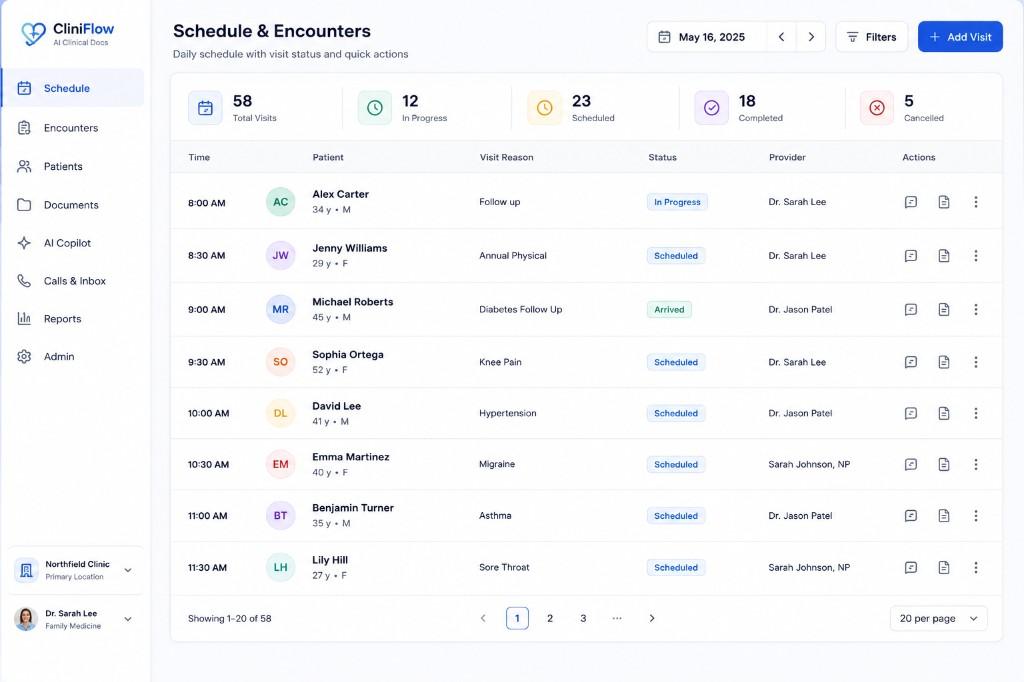
Product surfaces
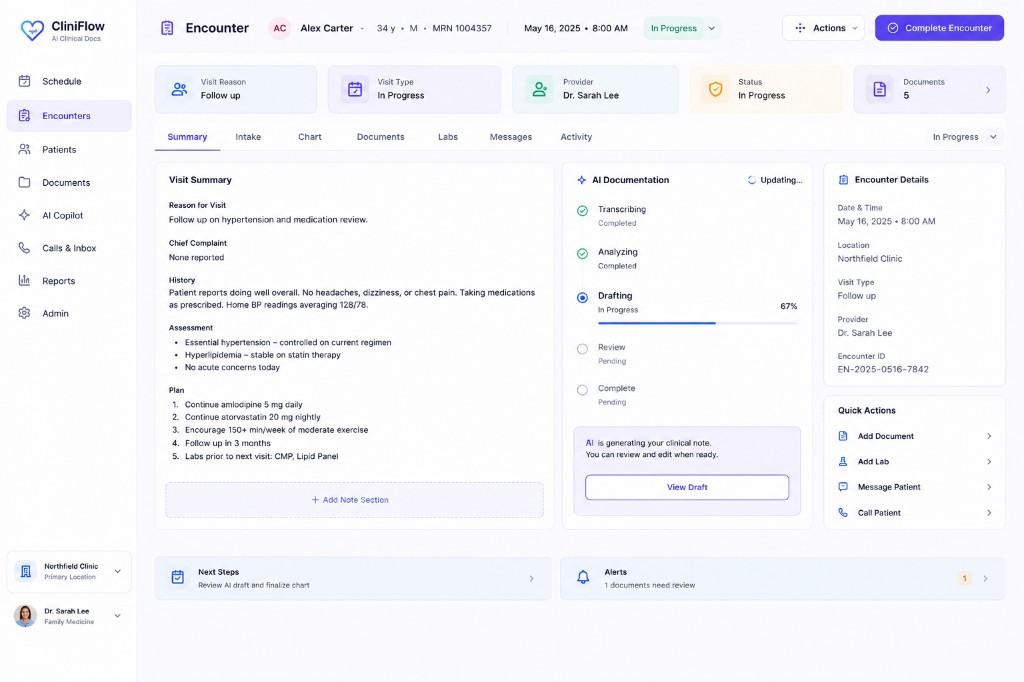
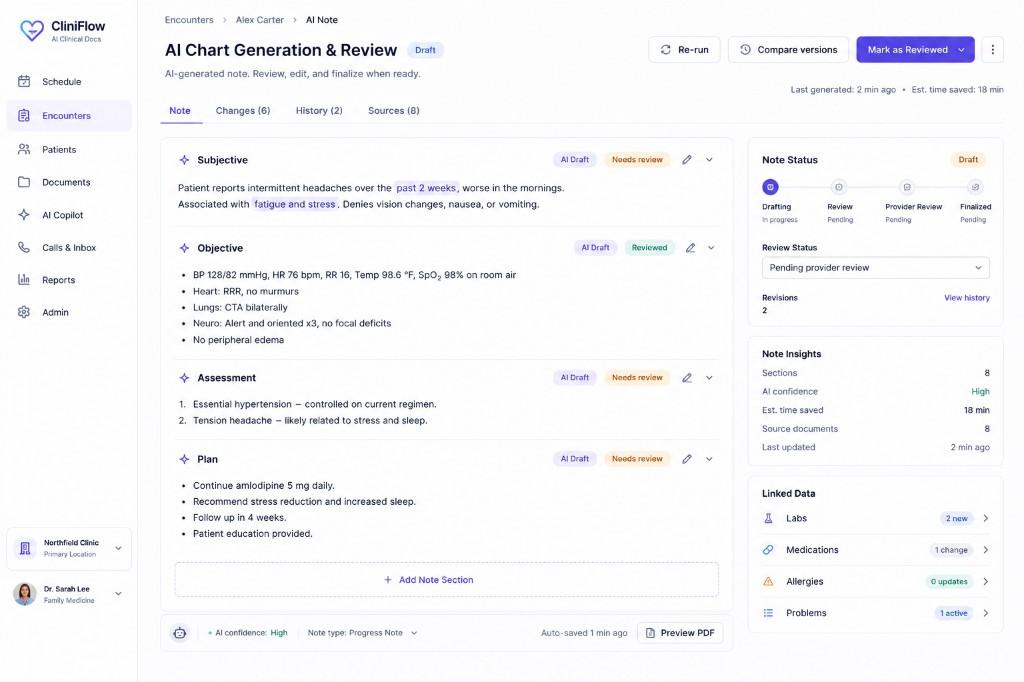
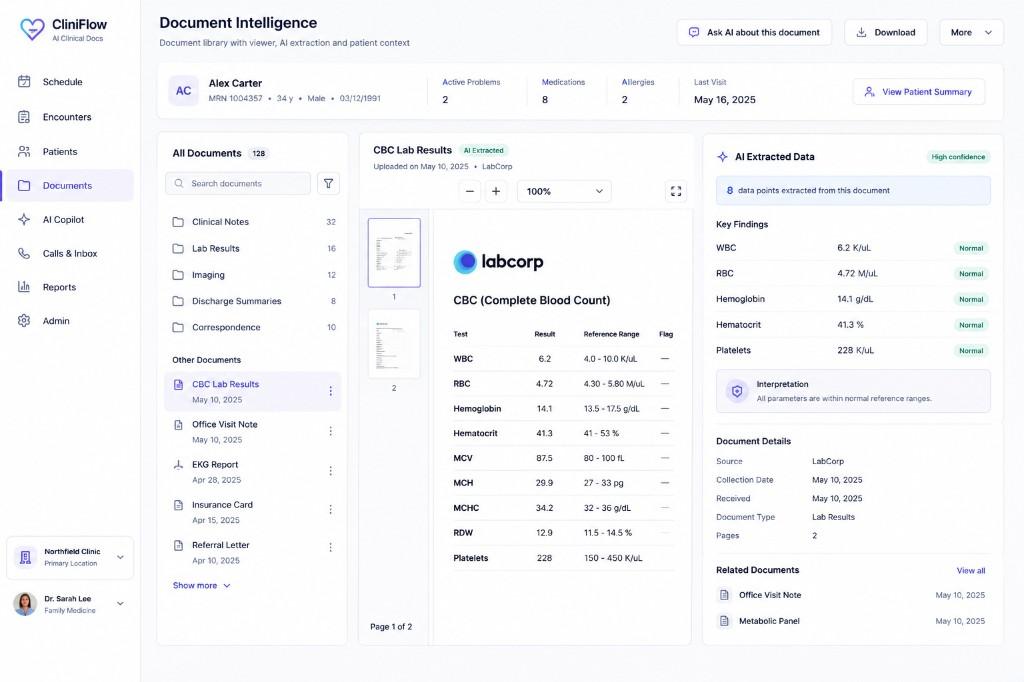
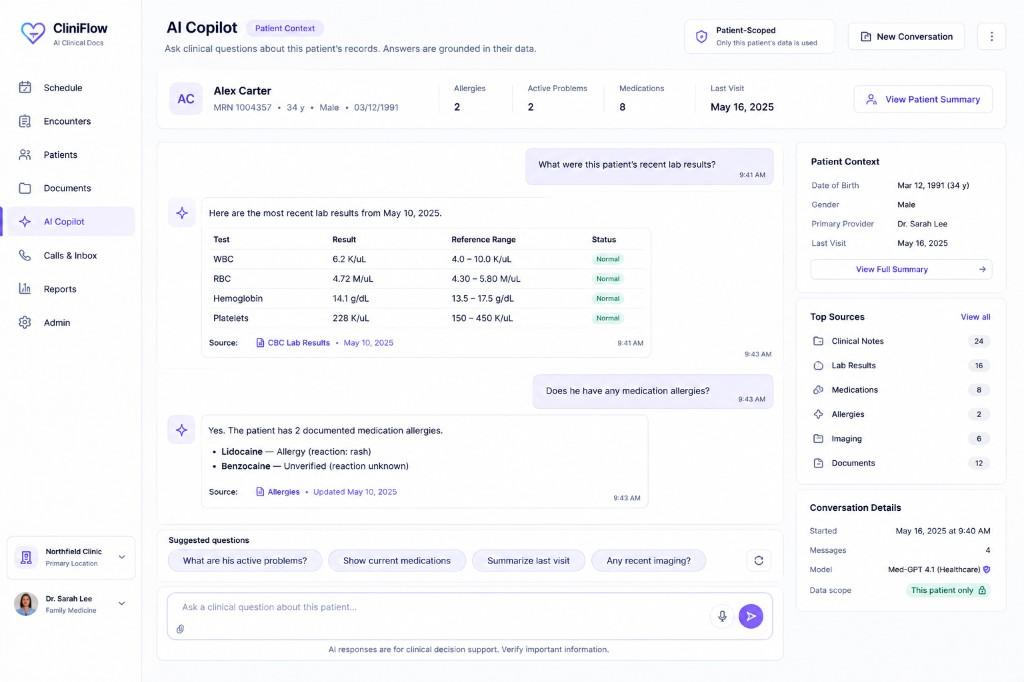
REPRESENTATIVE MOCKUPSIllustrative mockups of the same workflows and capabilities. Client UI is not shown.
Executive summary
I took raw clinical and operational requirements from a healthcare buyer and owned the full path to a production multi-tenant AI clinical documentation platform: discovery workshops and scope, system architecture, role-aware UX, full-stack implementation, async AI/RAG/EHR pipelines, staging/production delivery, and go-live support.
The platform helps clinics reduce documentation burden while keeping clinicians in control. Positioning for buyers: this is not a demo chatbot or a single “generate note” button. It is production-shaped clinical software with tenancy, reviewability, integrations, and operational tooling.
My role
Primary full-stack ownership across the entire engagement lifecycle.
Translated raw clinical/ops requirements into personas, flows, constraints, and a phased delivery plan
Shared scope, risks, and MVP vs later slices
Multi-tenant domain, API boundaries, async workers, RAG/search, realtime progress, EHR + telephony layers
Diagrammed system that scales beyond a prototype
Role-aware UX for nurses vs providers; encounter, documents, copilot, admin
Usable clinical surfaces, not generic dashboards
Vue SPA, Django API, chart automation, RAG + chatbot, EHR sync, calling/inbox, clinical modules, admin
Working product with integrations and AI pipelines
Env/config, workers, migrate/deploy path, staging validation, production handoff
Runnable environments and operational readiness
Discovery
What raw requirements looked like
- Nurses capture intake; doctors finish the chart later.
- We need notes from visit audio, but doctors must edit everything.
- Pull meds/vitals/allergies from the EHR; don’t make staff re-type.
- Providers should ask questions about this patient’s PDFs and labs.
- Multiple clinics, different roles, and we care about PHI handling.
- Inbound calls need a hold queue, never auto-attach a patient from caller ID.
How I structured discovery
- Persona & role map: nurse, provider, practice admin, platform superuser
- Journey map: schedule → encounter → intake/chart → documents → chatbot → calls → activity
- Constraint register: tenancy, PHI exposure, long-running jobs, vendor sprawl, auditability
- Capability pillars: EHR, security practices, automation/AI, RAG, provider chatbot
- Delivery slices: vertical slices that stay demoable before full EHR surface area
Product principles
- AI is a pipeline with progress and revisions, not a single opaque generation call
- Clinicians stay in the loop: edit, re-run, mark stale, review
- Retrieval and chat are patient-scoped, never a generic open sandbox
- EHR vendors stay behind an internal abstraction so the product core doesn’t lock to one adapter
- Security is designed in (tenancy, least exposure, audit trails), not bolted on at the end
Problem
Clinicians lose time to documentation and context-switching. Typical “AI note” demos fail in real clinics because production use needs more than a generate button.
Manual re-entry kills adoption
PHI in logs/events/feeds creates unacceptable risk
Opaque one-shot generation isn’t clinically acceptable
Prior records/labs stay trapped in PDFs
Generic LLM answers aren’t usable for charting decisions
Schedule, inbound calls, multi-clinic tenancy, admin config
Goal: Ship assistive AI documentation that behaves like production clinical software.
Constraints
- Strict clinic tenancy and role separation (nurse vs provider vs admin)
- Long-running AI jobs that must not block the clinical UI
- Sensitive content: minimize logging; avoid raw transcripts in activity feeds
- Multiple vendors: object storage, STT, LLMs, OCR, telephony, EHR APIs
- Retrieval quality and grounding for patient-scoped chatbot answers
- Evolving surface area without collapsing into an unmaintainable monolith
- Delivery pressure without sacrificing auditability or safe defaults
Solution: five pillars
A clinic-scoped clinical platform organized around five capability pillars.
EHR / EMR integration
Let clinics sync clinical data without hard-coding a single EHR vendor into every screen and service.
- Provider-agnostic EHR service layer with concrete adapters behind a stable internal API
- Clinical modules: medications, vitals, allergies, problems, appointments, documents
- Clinic-level enablement of modules so practices turn capabilities on intentionally
- Webhook / subscription handling where the EHR supports event-driven updates
- Admin-configurable chart/category mappings for field alignment across systems
- Optional bootstrap of nurse intake from EHR source data to reduce duplicate entry
- Sync as async jobs so EHR latency/rate limits don’t freeze the encounter UI
Buyer value: Practices can grow from manual intake to EHR-assisted intake/modules without a rewrite, and engineering can add adapters without fracturing the domain model.
HIPAA-oriented compliance & security practices
Healthcare-grade / HIPAA-oriented engineering and product controls. This is not a claim of formal HIPAA certification, HITRUST, SOC 2, or a completed BAA unless those are contractually accurate for a given engagement.
- Clinic-scoped domain model; queries/writes bound to the user’s clinic
- JWT auth, role-based provider/nurse flows, SAML SSO support, superuser admin isolation
- Activity/event payloads designed to avoid raw transcripts and full document text
- Presigned object-storage uploads; server validates storage keys
- HTTPS-ready public URLs, env-based secrets, no secrets in source control
- Chart revisions, processing attempts, structured run history for clinical review trails
- Explicit patient assignment on inbound calls (no auto-bind from caller ID)
- Chart categories and actions scoped to nurse vs provider responsibilities
Buyer value: Treat PHI as a first-class constraint in data model, event design, logging, and UI, not a policy document after ship.
Automation & AI usage
Use AI where it reduces documentation burden, while keeping humans in control of clinical content.
- STT on encounter / nurse audio via async workers, with transcript review before reliance
- Category/segment chart pipelines with prompts, model configs, live progress, edits, and revisions
- Nurse intake section proposals from capture + optional EHR bootstrap with review gates
- Parse lab PDFs/observations into structured panels/timelines
- Document ingest: OCR/extraction → chunking → embeddings with multi-doc progress
- QA hooks with rule-oriented validation and flags for human follow-up
- Status-driven runs: completing an encounter can trigger bulk chart processing
- Manual edits mark dependants stale instead of silently regenerating
Buyer value: Automation is inspectable: progress, attempts, revisions, and stale dependencies, so clinics can trust the workflow enough to use it day-to-day.
RAG pipeline (document intelligence)
Make prior records and scanned documents usable in clinical conversation without dumping entire PDFs into a prompt.
- End-to-end path: upload/EHR sync → OCR → chunk → embed → retrieve → ground answers
- Patient/clinic scoping on retrieval so vectors from other patients never leak
- OCR path for scanned clinical PDFs, not text-only happy paths
- Chunk strategies that respect tables/sections where possible
- Embeddings stored alongside relational clinical data (PostgreSQL + pgvector)
- Record workspace: queue, library, document reviewer, labs timeline, copilot sessions
Buyer value: Providers spend less time hunting through PDFs and more time making decisions with grounded, patient-specific context.
Provider chatbot for patient-specific discussion
Give providers a patient context tool, not a generic public chatbot.
- Conversations bound to a specific patient and clinic tenancy
- Answers grounded via RAG from that patient’s documents and related clinical sources
- Chat sessions with source-aware responses and document-centric review workflows
- UX colocated with the record workspace so discussion and document review stay together
- Retrieval before generation to reduce hallucinated clinical claims
- Role-appropriate access: provider tool, not patient-facing consumer chat
Buyer value: The assistant supports clinical discussion about this patient, which is the difference between a novelty LLM widget and a usable documentation companion.
What shipped
Day-of encounter list and people directory; role-split for doctors and nurses
Structured nurse intake + provider chart editing
Configurable categories/segments, variable prompts, automated runs, live progress
Vitals, meds, allergies, problems, intake summary, encounter info, clinical notes
Document queue, library, labs, reviewer
Patient-specific discussion grounded in retrieved clinical documents
Sync workflows, mappings, webhooks/subscriptions, intake bootstrap
Browser outbound; inbound hold → answer → assign via inbox
Clinic-wide operational events over SSE
Practices, users, chart templates, modules, prompt tooling
Architecture
Provider SPA (Vue) ── REST / SSE / WS ──► API platform (Django)Celery + Redis for AI, ingest, chart, and sync jobsPostgreSQL (+ pgvector) · Object storage (presigned)STT / LLM / OCR · Telephony · EHR adaptersPatterns I insisted on
- Schemas / repositories / services / clients so AI and EHR orchestration stay maintainable
- Async boundaries for STT, chart runs, OCR, embeddings, and EHR sync
- Realtime progress channels for long jobs (clinical trust requires visibility)
- Config-driven prompts, modules, and mappings for practice onboarding
Hard problems I solved
- Chart generation as a dependency graph: role scope, revisions, stale dependants; clinician control over automation
- EHR without vendor lock-in in the core: internal workflows + adapters; admin-configurable mappings
- RAG that is patient-safe: retrieval constrained to the patient/clinic context used by the chatbot
- Structured nurse intake: section workflow with optional EHR bootstrap and review gates
- Safe inbound calling: explicit patient assignment; no caller-ID auto-identity
- HIPAA-oriented engineering under delivery pressure: tenancy, least-exposure events, secret hygiene, audit-friendly run history
- Layered services: keep AI/EHR orchestration testable and extensible as scope grew
Delivery & go-live
Environments
- Environment-driven config for local → staging → production
- ASGI API + background workers + Redis for cache/queues/realtime
- PostgreSQL with vector support for document intelligence
- Deployable frontend build and backend migrate/restart path
Go-live readiness
- Secrets and env templates documented for operators
- Worker processes required for AI/EHR/ingest paths clearly identified
- Admin tooling for practice onboarding (modules, templates, mappings), not scripts alone
- Staging validation of critical journeys: encounter automation, document ingest, patient-scoped chat, EHR sync happy path
- Safe defaults for calling assignment and event payload exposure
Delivered as an operable product surface: configuration in admin, observable async jobs, and role-aware UX, so clinical ops can run day-of workflows without engineering in the loop for every visit.
Outcomes
- One patient context across schedule → encounter → documents → chatbot → calls
- Inspectable AI documentation: runs, attempts, revisions, stale dependencies
- Providers can discuss a patient’s records via grounded RAG chat instead of manual PDF search
- EHR data participates in intake and clinical modules through a stable integration layer
- Practices configurable through admin tooling with realtime clinic-day signals
Tech stack
Vue 3, Vite, Pinia, Vue Router, Ant Design Vue, Sass
Django, Django REST Framework, Celery, Redis, Channels
PostgreSQL, pgvector (embeddings / RAG)
AWS S3, cloud telephony (browser calling), serverless callbacks
LLMs, speech-to-text, OCR / document extraction, embeddings
EHR/EMR HTTP adapters, webhooks/subscriptions
JWT, SAML SSO
Engagement fit
Best fit
Healthcare / regulated SaaS, AI + integrations, multi-tenant products
Not a fit
“Just add ChatGPT to our form” with no tenancy, review, or data controls
Got a clinical product to ship?
Available for remote roles and freelance engagements with US timezone overlap.